

Sermon preached on Sunday 14th September 2025 – The Feast of the Exaltation of the Holy Cross
Fr Leonard Doolan – St Paul’s Athens
I invite you to exercise your olfactory function this morning. Don’t worry it means ‘smelling’. For a moment just close your eyes and try to imagine your are moving your hand slowly, gently, through the bright green leaves of a basil plant. Try to recapture that wonderful deep scent that wafts from the leaves, filling the air around you with freshness and sweet pungency. Walking away you smell your fingers where the scent of the basil lingers longer. The amazing affect of the king of herbs, basil.
I’m calling it the king of herbs, because basil in Greek – vasilikos – means royal.
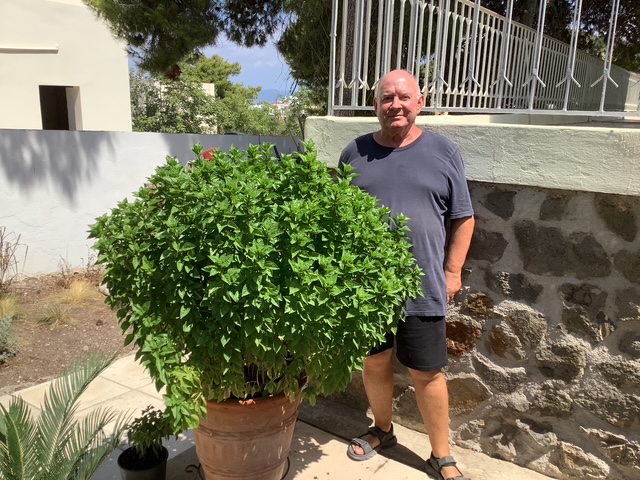
In my front garden on the island of Aegina I have a basil plant the size of a bush. I know I don’t have long legs, but when I stand beside the bush, in its elegantly shaped terra cotta pot, it stands higher than my shoulder. Lynne and I have sent photographs of it to friends, and it has been praised from as far away as Connecticut. I will try to put the picture on the church website and Facebook. Basil, the royal herb! I’ll return to the basil in a few minutes.
One of my dear friends, who sadly passed to eternal rest some years ago, at far too early an age, was a monk at a Benedictine Abbey, and a very fine cantor, and an outstanding Guestmaster to those visiting the abbey for spiritual rebooting.
I recall disagreeing with him only once. Our disagreement was about the feast that the universal church celebrates on this day, September 14th, the feast of the Exaltation of the Holy Cross. Fr. Norbert argued that there was no place for this feast day, and that it detracted from the emphasis of the cross on Good or Great Friday. For him that’s the day of the Holy Cross
I didn’t agree. Of course the Cross has its central place on Good Friday, it is the ‘crux’ of that day’s salvation event. However Good Friday is so loaded with emotion for Christians, with so many layers of conflicting feelings, devotional meditations and powerful symbolism it can feel overwhelming. On Good Friday too, the preacher has a great responsibility in attempts to share with the faithful some worthy thoughts on what it is that Christ has done for us, wrestling with the often conflicting theories of Atonement – that’s a word that refers to the purpose and outcome of Christ’s death – ransom, victory, satisfaction, penal substitution, governmental, scapegoat. How can the preacher do justice to what God is doing in Christ on that day, and how can God’s action be reduced to a theory – whichever one suits your theological aptitude best?
So much to say, to do, to contemplate – and then there are those who revel in the pain and the suffering side of the Crucifixion. My goodness the options are endless.
So, September 14th, the Exaltation of the Holy Cross, despite what my friend Fr. Norbert thought, is a rich opportunity to explore some other great themes without being stifled by the portents of Christ’s death. It gives us freedom to talk about beauty, glory, and joy for example.
Beauty, because we are able to reflect on the beauty of self-giving, of the Christian life at its best when it is a cross-centred life, a life of generosity, of love towards humanity, of compassion for the poor and underprivileged, of small gestures of kindness towards another which is nothing short of beautiful.
Glory, because despite all we focus on for Good Friday, the death of Jesus, his raising up on the cross, is an ‘exaltation’. The writer of the 4th gospel, St. John, frequently plays with the words about being raised up in crucifixion and raised up in glory. Of all the gospels it is the 4th that captures the glory of the cross – the cross is, as it were, the gateway to the empty tomb and the Risen Christ. The cross is not a shrine to death, but but a throne of glory.
Joy, because we are Easter people, and Alleluia! is our song. We know that the cross was a brutal instrument of death wielded by a harsh Roman repressive regime, but the Cross is also the holy sign to us that Christ is risen, and that by means of the cross a new universal world order has begun – a new covenant between God and humanity.
The Cross – Beauty, Glory, Joy. The good news for all the world, and the universal sign of our identity, that transcends all languages, races, skin pigmentation, and ethnicities. A new message of hope and a message that we have an obligation to share with others, for it would be wicked to keep to ourselves the treasures of beauty, glory and joy. It is for all the world to know.
glory and joy. It is for all the world to know.
A long time ago a woman called Helena discovered all of this for herself, and she did quite a bit to share her discovery with us. Helena was born on the British isles. Some say she was from York, others Colchester. Both were significant Roman garrison towns. Like the great English author, Evelyn Waugh, I prefer Colchester as her birthplace and that she was the daughter of King Coel – he is thought to be the king known in the children’s nursery rhyme, “Old King Cole was a merry old soul, and a merry old soul was he…” His name was given to Colchester, which means the military camp of Coel.
Helena married a Roman general, Constantius, who served both in Colchester and in York. Their child was born in York – his name, Constantine, who would later become Emperor, and establish his Imperial court at the ancient city of Byzantium, renamed Constantinople. Helena was interested in religion, and in older age was baptized Christian. Her son took longer to decide.
In her old age she got fidgety to discover more about the things of her faith. With her son’s support and a bag full of imperial cash, and with the blessing of the Pope in Rome, Sylvester, Helena set out with a huge entourage of courtiers, architects and builders to the much neglected Roman city of Aelia Capitolina. This was where she had to go to find out more about things referred to in the gospels, because Aelia Capitolina is what the Romans called Jerusalem.
There followed one of the most extensive programmes of imperial building works ever recorded, but not villas for royal courtiers and governmental public buildings, nor for games and theatre productions, but churches, basilicas. There’s that Greek word for royal again for the basilicas were for the worship of the King of Kings. Basilicas were erected on the site of the birth of Jesus in Bethlehem, the site of his burial and resurrection, the place where he ascended in to heaven. All of these still in use two millennia later.
And lastly, where was Jesus crucified? What happened to the cross? Where might it have been discarded? How would she find it? Calculations were made, but so much discarded wood – how to know which might be the cross of Jesus? A huge basil bush was growing nearby. I told you I would return to the basil. You must be fed up waiting! Surely, thought Helena in this tradition, the cross will be buried under the Royal Herb, the King of Herbs. And so we learn of the discovery of the True Cross by Helena, Empress and Saint, the cross of beauty, glory and joy.
Before setting off she had explained her big adventure to Pope Sylvester. In the conversation put into their mouths by Evelyn Waugh, Sylvester asks Helena ‘You’ll tell me won’t you? – if you are successful.’ ‘I’ll tell the world’, said Helena.
No Comments