

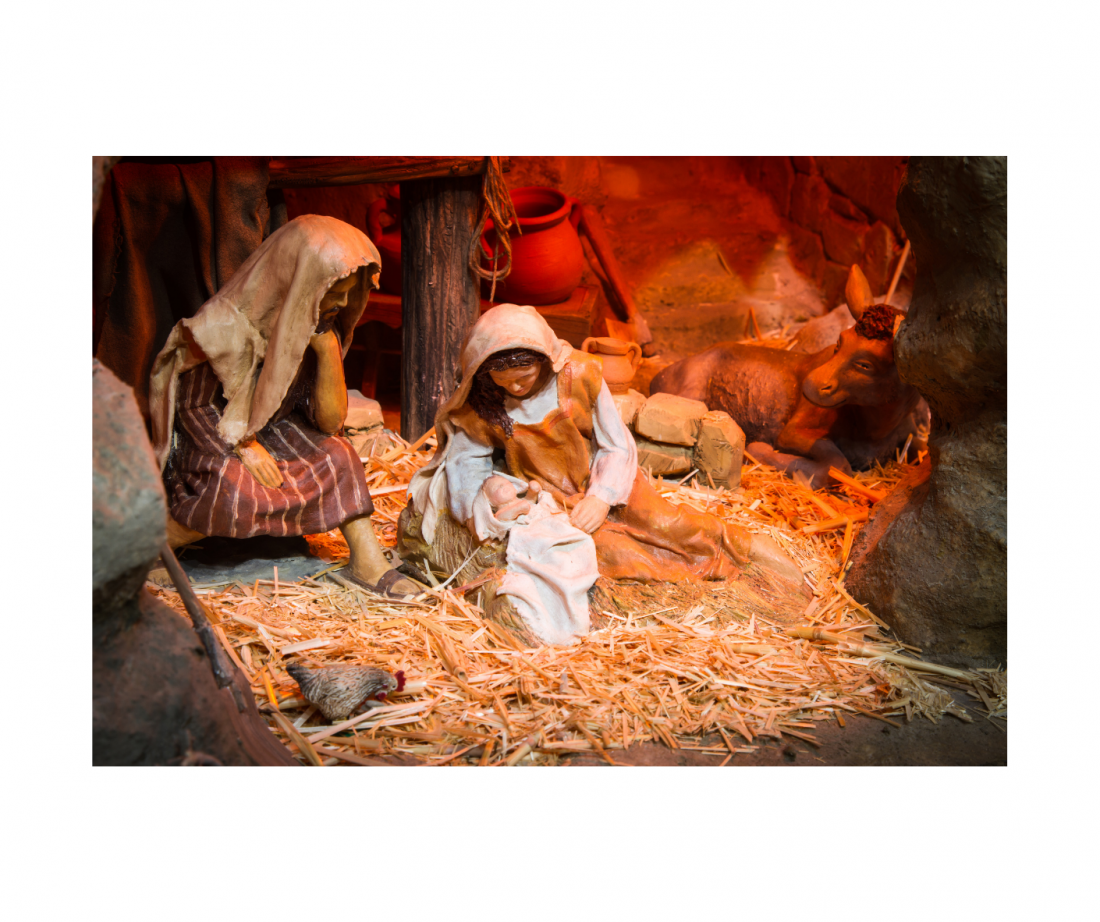
Christmas Reflections 2025 – by Fr Leonard Doolan
Christmas Reflection from a Greek island.
‘And there was with the angel a company of the heavenly host, praising God and saying, “Glory to God in the highest heaven, and on earth peace to all men’ (Luke 2, 13-14).
This is the great news that is the very heart of Christmas – the song of praise that repletes heaven and earth that Christ is born – that God’s Messiah is among us – that, in the profound words of St. John, ‘the Word was made flesh and dwells among us.’ (John 1)
This is the historical daily reality that we celebrate very intently at Christmas – but it is a reality that had been foretold by generations of Godly people, and a reality that is told now, and by Godly people in generations to come, because the birth of the Christ-child is an action of God, as real as God’s act of Creation itself. The story, mostly detailed in St. Matthew and St. Luke, captivates us – so familiar that we hardly need to double check it, and in our mind’s eye there are subliminal reminders from generations of artists in both the eastern and western traditions. Some of the most beautiful of our Christmas cards will capture the details of this event. Nativity plays in churches and schools will bring delight to those in attendance and anguished nerves to parents hoping their child will remember words, actions, movements – Mary, Joseph, a donkey, shepherds, hundreds of sheep, Wise Men – all dramatically presenting this best known of universal stories. And of course an angel of God, an angel who is surrounded by a heavenly host. The child is born.
‘And they wrapped him in cloths and placed him in the food trough because the guest room was full.’ (Luke 2, 7).
I’m grateful to one Orthodox commentator for the archaeological insight that leads me to this translation. Fr. Mark Sietsema* sets the scene for the arrival of the Holy Family in Bethlehem. In this culture it is unheard of to travel back to one’s family town and not stay there in the family home. However, everyone was returning home for the census, so St. Luke informs us that Joseph’s family home – which would have been modest – was already full up, so the late arrivals had to use the slightly sunken part of the home where there would have been some domestic animals, living cheek by jowl with the family. Archaeologists have found eating troughs hewn out of the floor space in houses in this area and period. So it is perhaps possible that the baby Jesus was placed into the feeding trough in that part of the house rather than in the living quarters.
The same commentator gives some hints too about the language used by St. Luke. In Greek the word for an ‘inn’, as in Luke’s story of the Good Samaritan is pandocheio. Any tourist visiting Greece now will be familiar with the modern Greek word for a hotel – zenodocheio – not so remote from the word used by Luke in his very famous Good Samaritan parable that illustrates ‘love in action’. However, in his description of the details surrounding the birth of Jesus, it is not the word for inn or hotel that is used by St. Luke, but rather kataluma. This can translated as a guest accommodation. So just perhaps there was no room left in the family guest quarters, thus Jesus was born in the domestic animal lower quarter of the house, and placed either in a trough hollowed out in the ground or even a stone-hewn trough on the ground.
In mentioning such speculative detail there is no intent to re-write the familiarity of the gospel record of the birth of Christ, for the reality remains unchanged, but just an attempt to make us think about the context, and what that context might be saying to us.
The idea of the feeding trough allows the imagination to exercise. In many Orthodox icons of the Nativity of Christ, the babe is lying in something resembling more a sarcophagus than a wooden structure with straw peeping through the wooden slats – an image that is maybe familiar to us through western Mediaeval and Renaissance art. There is a profound statement being made by placing the newborn in a sarcophagus-looking receptacle, because it connects us with the sepulchre and the burial rites of Christ after the crucifixion. Here is a ‘sign’ of the way in which the ‘crib and the cross’ are inalienably fused. They are a sign to us of the paradoxical all powerful humility of our God as he enters fully into his created order.
Often we reflect on the humility of God in Christ on Good Friday, pondering as we do about the great risk God took in emptying himself into humanity. (see Philippians 2). However the birth of this baby is the great risk God takes that leads ultimately to the cross and the miraculous renewal of human life beyond its apparent boundaries and finality.
It is in this birth that time becomes – to our reckoning at least – fused and confused. The one who is the Alpha and Omega, beginning and end becomes human flesh in time and place, in history and in reality.
We have had the blessing of the Advent season to reflect on the restraints of human measured-time. At the Advent Sunday Carol service at Westminster Abbey (30th Nov 2025), the Dean said in the Bidding Prayer that Advent is the ‘season when we look back at our future, and our future looks back at us’. How challenging is this? – in the birth of a baby in a trough time stands still, yet this moment has been prophesied through the ages from the past, and through Christ it is projected into the future – and we are all fully engaged in this. The joy of birth and the grief of death are located in our midst, in our neighbourhood. Verse 3 of the great Advent hymn, ‘Lo he comes with clouds descending’ (words by John Cennick 1752, reworked by Wesley 1758) setting the Advent mood and imminent coming of the Messiah, reads like this in verse 3,
‘Those dear tokens of his passion, Still his dazzling body bears, Cause of endless exultation, To his ransomed worshippers, With what rapture, Gaze we on our glorious scars.’ At one moment we are contemplating the swaddling clothes and the linen garment of the crucified Christ found in the empty tomb.
We started with the angel and the heavenly host praising God and announcing good news. It is a never-ending chorus of joy. Where were they on Good Friday? Absent? Certainly not – I would propose that all the heavenly host had simply taken a huge deep breath, ready to belt out the euphony of Alleluias on the third day and to perpetuate their heavenly song about the Good news of God revealed in Christ. What richness to reflect on at this season.
I will end with some reflective words from St. Isaac the Syrian (7th century Bishop of Nineveh). They are an extract from his Nativity sermon. You may wish to read it or listen to it on Christmas Eve.
This Nativity night bestowed peace on the whole world; so let no one threaten;
This is the night of the Most Gentle One – Let no one be cruel;
This is the night of the Humble One – Let no one be proud.
Now is the day of joy – Let us not revenge;
Now is the day of Good Will – Let us not be mean.
In this Day of Peace – Let us not be conquered by anger.
Today the Bountiful impoverished himself for our sake;
So, rich one, invite the poor to your table.
Today we receive a Gift for which we did not ask;
So let us give alms to those who implore and beg us.
This present Day cast open the heavenly doors to our prayers;
Let us open our door to those who seek our forgiveness.
Today the DIVINE BEING took upon Himself the seal of our humanity,
In order for humanity to be decorated by the seal of DIVINITY.
Greetings from a Greek island. Peace and goodwill to all. Have a blessed and holy Christmas. Amen.
*Fr. Mark Sietsma, the Presiding Priest at the Holy Trinity Greek Orthodox Church in Lansing, MI
No Comments